
How to Start an Online Coaching Business in 10 Steps (and Attract Clients Consistently)

A lot of people are sitting on a goldmine of valuable expertise without even realizing it.

Think about it: You’ve spent years building a business, managing teams, solving complex problems, or mastering a skill that now feels like second nature to you. What feels completely obvious to you is often exactly what someone else is desperate – and willing to pay – to learn.

That’s the power of the online coaching model.

Instead of constantly trading time for dollars, coaching allows you to package what you already know, help people get real results, and build a business that can scale way beyond your daily calendar.

Of course, knowing your craft and building a profitable business around it are two very different things.

Most aspiring coaches get paralyzed right at the starting line. They overthink their offer, second-guess how to stand out, or obsess over logos, tech stacks, and website fonts before they’ve ever had a single conversation with a potential client.

Let’s skip the fluff.

You don’t need a massive following, a bloated marketing funnel, or decades of formal teaching credentials to launch. You just need a specific niche, an offer that solves an actual pain point, and a reliable way to get in front of the right people.

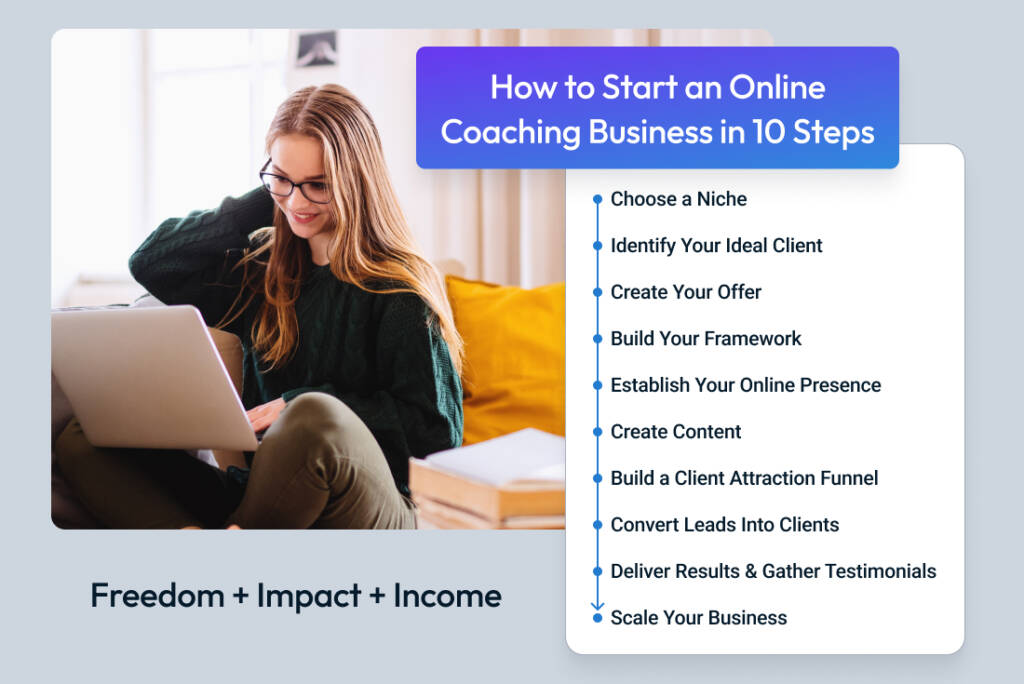
Here is your straightforward, 10-step roadmap to launching your online coaching business, signing clients consistently, and turning your expertise into impact.

Visual roadmap showing the 10 steps to start an online coaching business, from choosing a niche and attracting clients to scaling with group programs and digital products.

Step 1: Choose a Highly Specific (and Profitable) Niche

The quickest way to fail as a new coach is to try and help everyone.

It feels safe at first. You don’t want to leave money on the table, and you likely have a broad skill set. But when your message is designed to appeal to everyone, it ultimately resonates with no one. If your niche is too vague, prospects have to do mental gymnastics to figure out if you can actually help them.

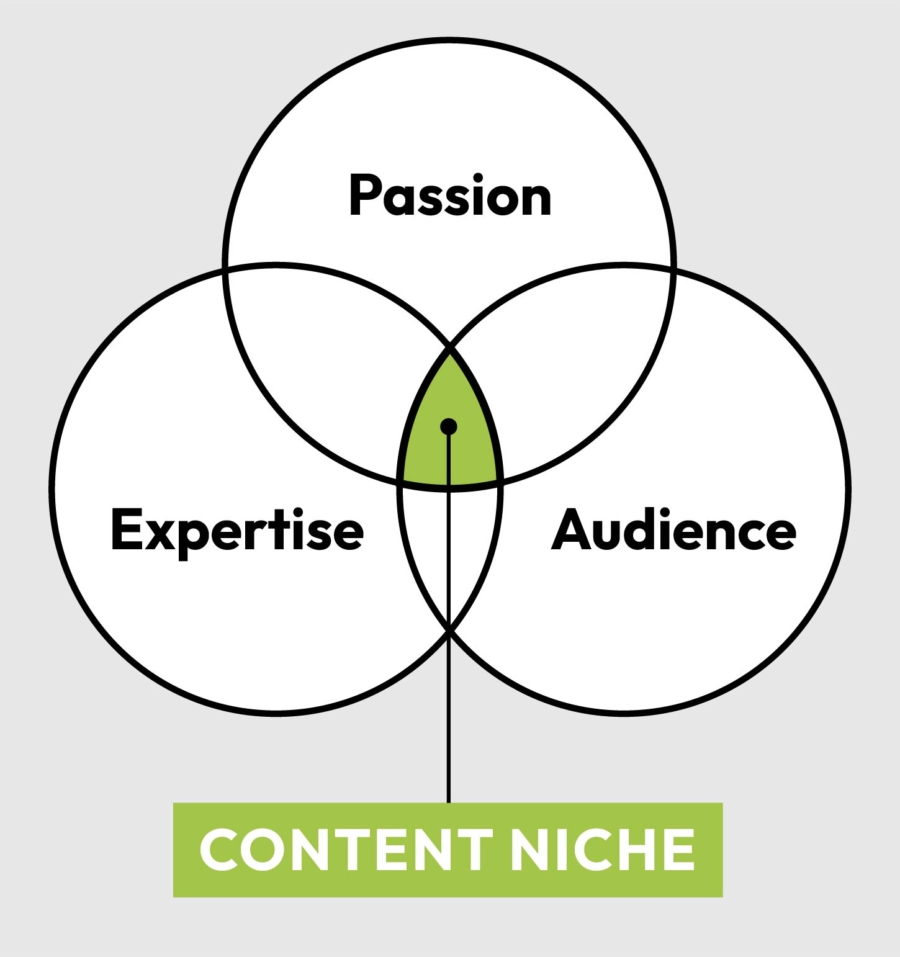
A profitable coaching niche sits at the crossroads of three core elements:

  • Your Real-World Expertise: What you can genuinely help people achieve based on your track record.
  • Market Demand: Problems people are actively spending money to fix.
  • An Urgent Desire: A specific, tangible outcome your audience wants right now.

Broad & Forgettable: “I’m a life coach.”

Specific & Premium: “I’m a career strategist for mid-level corporate professionals looking to break into the C-suite.”

Broad & Forgettable: “I do business coaching.”

Specific & Premium: “I help freelance copywriters package their skills into high-ticket retainer packages.”

To pin down your niche today, fill in this blank:

“I help [specific audience] achieve [specific result] without [their biggest frustration].”

Example: “I help busy corporate moms lose their first 15 pounds without giving up carbs or spending hours meal prepping.”

If people can’t read your bio and immediately know whether they belong in your world, it’s time to tighten up your focus.

Step 2: Decode Your Ideal Client’s Brain

You can’t market effectively to a demographic on a spreadsheet. You need to understand the human being behind the screen.

Many coaches glance at this step and say, “Got it, I help entrepreneurs.” But there is a massive gap between targeting “entrepreneurs” and understanding the exact, middle-of-the-night anxieties a bootstrap founder faces when cash flow dips.

To build an offer people will actually pay for, you need to answer these questions honestly:

  • What specific, nagging problem keeps them awake at 2:00 AM?
  • What solutions have they already tried that completely failed them?
  • What does a “win” look like to them six months from now?
  • What is the emotional cost if they change absolutely nothing?

Conduct Actionable Market Research

To find these answers, skip the guesswork and do some intentional market research. Mine the digital spaces where your audience hangs out. Browse targeted Facebook groups, monitor LinkedIn discussions, read podcast reviews, and track social media conversations. Pay close attention to the exact language and emotional words people use to describe their struggles. Mirroring their own words back to them will radically improve your marketing efforts.

Let’s look at the difference specificity makes:

Generic TargetHigh-Intent Ideal ClientSmall business owners.Service providers who are sick of relying on word-of-mouth and need a predictable client acquisition system.

Notice how the second option immediately gives you a content strategy, a clear problem to solve, and a reason to charge premium prices.

Step 3: Package an Offer People Actually Want to Buy

Here is a hard truth you need to embrace: Clients do not buy coaching hours. They buy outcomes.

Nobody wakes up in the morning and thinks, “Wow, I really want to buy a 60-minute Zoom call today.” They wake up thinking:

  • “My business revenue is stalling.”
  • “I’m completely burnt out at my job.”
  • “I need to get my health under control.”

Stop selling the logistics of your coaching and start selling the transformation.

Flip the Script on Your Messaging

  • Instead of selling features: “Includes 8 weekly calls, 4 PDF worksheets, and 24/7 email support.”
  • Sell the outcome: “A 60-day sprint designed to help independent consultants sign their next three high-ticket retainer clients.”

The first version describes administrative work. The second version promises a breakthrough.

Keep Your First Offer Stripped-Down

Don’t worry about multi-tiered packages, membership sites, or complex course additions right now. Create one flagship offer that takes one specific type of person from Point A to Point B.

Depending on your niche, that delivery might take the form of intense one-on-one sessions, a structured coaching program, or premium coaching packages. Eventually, you can blend your time with digital products. For now, just create a clean solution that matches your audience’s current needs and gives them a clear path to results. You can add the bells and whistles later once you have cash flowing into your bank account.

Step 4: Map Out Your Signature Framework

When someone invests in a coach, they are buying confidence. They want to see that you aren’t just winging it on your calls-they want to know you have a proven path to get them results.

This is where your Signature Framework comes in. It’s simply your proprietary, step-by-step method organized into 3 to 5 clear phases.

[Phase 1: Foundation] ➔ [Phase 2: Execution] ➔ [Phase 3: Scaling & Results]

Mapping this out pays massive dividends down the road. This framework will eventually become the structural backbone for your future group coaching programs, online courses, memberships, workshops, and webinars-allowing you to scale your expertise seamlessly without reinventing the wheel.

If you coach people on how to launch a freelance writing business, your framework might look like this:

  1. Phase 1: Position Your Portfolio (Setting up your high-converting landing page).
  2. Phase 2: The Cold Pitch Blueprint (How to find and message high-paying editors).
  3. Phase 3: Retention & Scaling (Turning one-off articles into monthly contracts).

When you can visually show a prospect, “Here is exactly where you are stuck, and here is the 4-step path we will take to fix it,” the sales conversation completely changes. You instantly shift from a generic service provider to a trusted authority.

Step 5: Build a Clean, Simple Digital Business Card

Please do not spend three months tweaking a logo or trying to learn complex web design. It is a massive form of productive procrastination that keeps you from doing the real work: talking to potential clients.

You do not need a massive 15-page website to launch. You just need a clean, professional online destination that answers three basic questions within five seconds of a visitor landing on the page:

  1. Who do you help?
  2. How do you help them achieve their goals?
  3. What is the exact next step they should take to work with you?

Whether you launch on WordPress or a streamlined landing page builder, your professional website needs to clearly communicate your expertise, showcase client results, and make it effortless for prospects to take action. This is where you leverage powerful social proof, like detailed case studies and direct testimonials, to rapidly build trust.

Need inspiration? Browse these examples of excellent coaching websites to see how successful coaches communicate their value, structure their pages, and guide visitors toward becoming clients.

Your homepage should be straightforward: A compelling, customer-focused headline, a brief section establishing your credibility, a quick breakdown of your primary coaching program, and a prominent button that says “Book a Strategy Call.”

Keep the tech friction low so your clients can find you easily.

Step 6: Create High-Value Content That Demands Attention

You don’t need to become a full-time content creator, post Reels five times a day, or try to go viral with dancing trends.

Your content has one simple job: To prove you understand your ideal client‘s problems better than anyone else.

The easiest way to generate endless content ideas is to look at the exact objections, misconceptions, and questions your audience deals with every day:

  • What common mistakes are they making before they find you?
  • What industry myths are keeping them stuck?
  • What is a “quick win” you can give them in a 300-word post?

If you’re struggling to decide what to post, these proven coaching content ideas can help you create valuable content that attracts potential clients without feeling promotional.

The 70/20/10 Content Mix

To keep your audience engaged without burning them out (or sounding like a broken sales pitch), split your posts into three categories:

  • 70% Value & Education: Break down concepts, share actionable tips, and solve micro-problems for free.
  • 20% Culture & Authority: Share your personal story, behind-the-scenes lessons, or case studies of how you overcame these exact challenges.
  • 10% Clear Promotion: Direct calls-to-action inviting people to book a call, join an email list, or apply for your program.

Don’t try to be everywhere at once. Just show up where your audience already hangs out. Whether that’s LinkedIn, an email inbox, a podcast, or YouTube, choose one or two channels and commit to dropping high-value content there consistently.

Step 7: Set Up a Frictionless Client Attraction Funnel

Social media algorithms are unpredictable. If your entire marketing strategy relies on people seeing your daily posts, your business is sitting on shaky ground. You need a system that captures attention and converts it into owned leads.

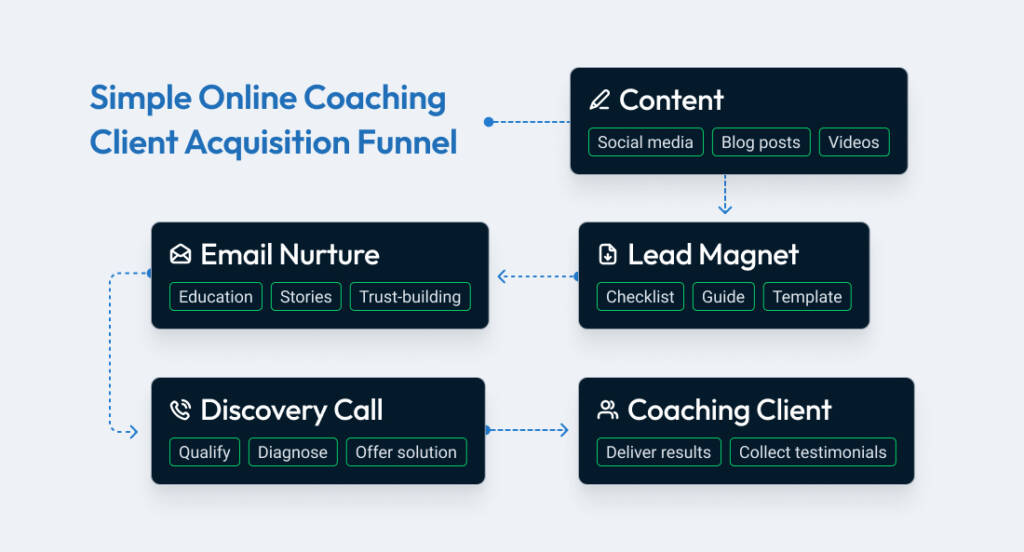
A simple, highly effective ecosystem looks like this:

Coaching business sales funnel showing how content, lead magnets, email marketing, and discovery calls convert prospects into paying coaching clients.

High-converting lead magnets can include quick checklists, plug-and-play templates, mini-courses, or bite-sized strategic guides that solve a single, hyper-specific problem. Once someone opts in, you can nurture the relationship via thoughtful email marketing and invite them to a discovery call when they are ready for the next level.

As your client base grows, this simple setup can naturally mature into a more advanced sales funnel, but the fundamentals never change: attract, deliver value, and invite.

How to Build It This Week:

  1. Create a Lead Magnet: Create a highly actionable, 2-page resource that solves a specific problem (e.g., “The 10-Minute Audit to Uncover Your Best Coaching Niche”).
  2. Set Up a Landing Page: Use a simple form where people trade their email address for the resource.
  3. Follow Up via Email: Send a short sequence of 3 to 4 emails over the next week that deliver extra value, share a success story, and invite them to hop on a free discovery call with you.

Step 8: Master the Consultative Discovery Call

If you hate the idea of being a pushy salesperson, good news: aggressive sales scripts don’t work for high-ticket coaching anyway.

The best discovery calls don’t feel like a high-pressure sales pitch. They feel like a collaborative strategy session. Your goal isn’t to twist someone’s arm into buying; it’s to determine if you can actually help them close the gap between where they are and where they want to be.

To make this effortless and professional, utilize streamlined scheduling tools and video conferencing platforms like Google Meet to automate the booking experience for your prospects.

Ask, Don’t Tell

Spend the first 80% of the call asking targeted questions:

  • “What is the biggest bottleneck holding your progress back right now?”
  • “What have you tried in the past to fix this, and why do you think it didn’t stick?”
  • “If we solve this problem completely, what does your life or business look like six months from now?”

If it’s a great fit, seamlessly transition: “Based on what you just shared, here is exactly why you’re feeling stuck, and here is how we would tackle that inside my program. Would you like to hear how that works?”

Suddenly, sales stops feeling sleazy and starts feeling like a natural extension of your service.

Step 9: Obsess Over Client Results (Your Best Marketing Tool)

The absolute fastest way to scale a coaching business isn’t through fancy Facebook ads or copywriting tricks-it’s through undeniable client transformations.

When your clients get incredible results, they become walking billboards for your brand. They renew their contracts, and they enthusiastically refer their peers to you.

[Incredible Client Results] ➔ [Powerful Word-of-Mouth] ➔ [Effortless Premium Sales]

Don’t wait until the end of your program to check in on success. Set clear, measurable benchmarks on Day One. Celebrate the small milestones along the way-like a client launching their first landing page or hitting a health goal. Consider using a simple progress-tracking doc or dashboard so clients can visually see how much ground they’ve gained.

When your program ends, capture that magic. Ask your clients specific, open-ended questions: “What was your biggest breakthrough during our time together, and what would you tell someone who is on the fence about joining?” These real, emotional stories and strong testimonials are worth more than any sales copy you could ever write.

Step 10: Scale and Reclaim Your Time

Once your calendar is full of 1-on-1 clients and your methodology is consistently delivering results, you’ll inevitably hit a time ceiling. There are only so many hours in a week you can spend on video calls.

Scaling your business doesn’t mean working until you burn out. It means shifting your business model to create leverage.

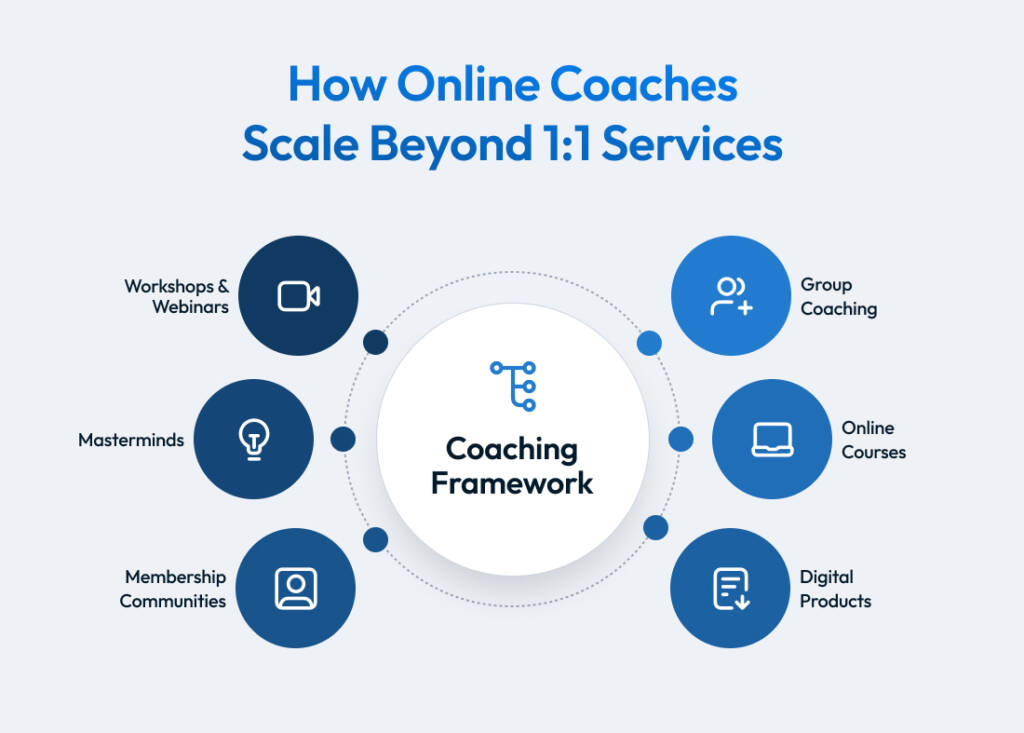
Diagram showing how coaches can scale beyond one-on-one coaching using group coaching, online courses, memberships, digital products, masterminds, and workshops.

Top industry leaders eventually break past the 1-on-1 ceiling by introducing highly scalable offers:

  • Group Coaching: Move from 1-on-1 calls to a 1-to-many model where you coach a cohort of clients simultaneously.
  • Online Courses & Digital Products: Package the foundational, repetitive parts of your teaching into self-paced training assets, freeing up your live sessions for deep, high-tier strategic support.
  • Masterminds: Bring together high-level clients who want your top-tier strategy alongside peer-to-peer networking and accountability.

By productizing your process, you can dramatically scale your income while keeping your calendar completely under your control.

Behind the Scenes: The Boring (but Critical) Business Basics

Marketing and client attraction get all the spotlight, but a truly sustainable business requires a solid foundation. You don’t need a corporate legal team to get started, but taking care of a few administrative essentials early will save you massive headaches later:

  • Pick a Legal Structure: Depending on your jurisdiction and long-term goals, this typically looks like operating as a sole proprietorship or forming an LLC. Sit down with a qualified accountant or attorney to see what makes sense for your liability and tax structure.
  • Use a Solid Coaching Contract: Never start working with a client until they sign an agreement that outlines your cancellation policies, payment terms, boundaries, and clear expectations.
  • Frictionless Invoicing: Use platforms like Stripe or PayPal to streamline payment processing and make it easy for clients to pay you securely through credit cards or recurring payment plans.

Final Thoughts

If you take just one insight away from this guide, let it be this: Stop waiting for everything to feel perfect before you launch.

The most successful online coaches didn’t start with a flawless website, a polished tech stack, or thousands of email subscribers. They built momentum by taking imperfect action, having real conversations, and refining their offers based on real-world feedback.

As the coaching industry continues to expand rapidly, the practitioners who combine real, transformational coaching skills with clean, consistent marketing systems are the ones who will capture the greatest opportunities online.

When you’re ready to streamline the moving parts of your business, Kartra provides an all-in-one platform to handle your landing pages, email marketing, client onboarding, and checkout systems seamlessly. Grab a free trial to see how it can simplify your workflow, and focus your energy on what matters most: changing lives with your expertise.